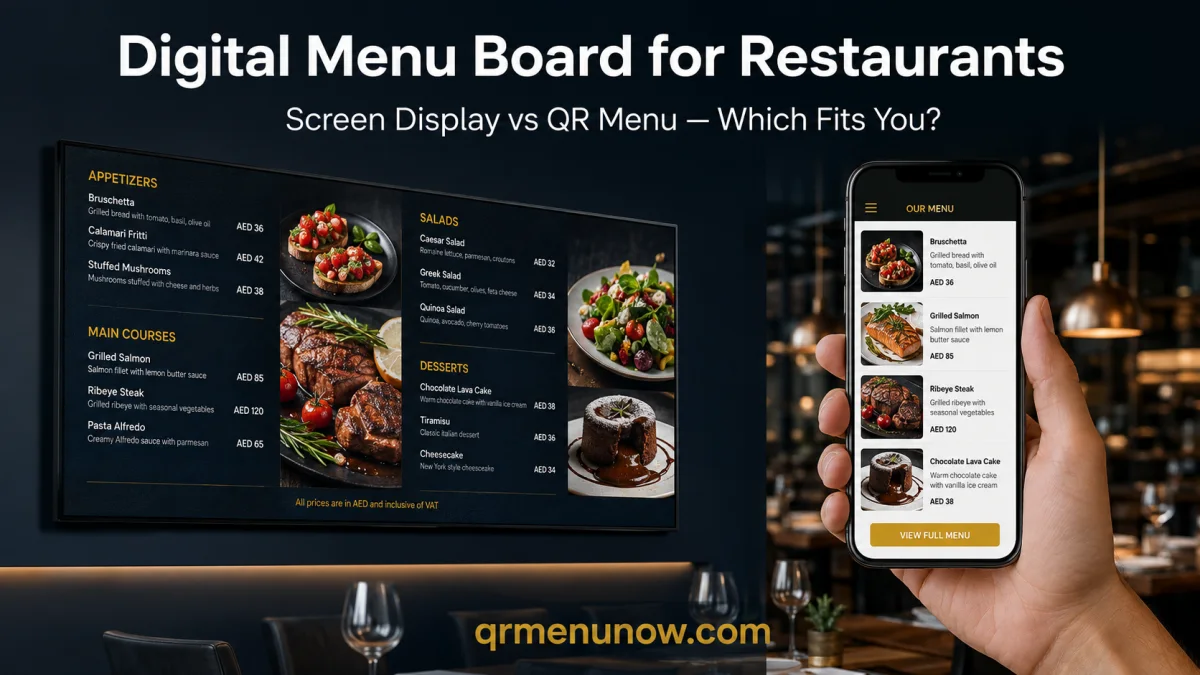
If you have been looking into a digital menu board for restaurants, you have probably noticed that the category covers a wide range of very different products — from large wall-mounted screens running digital signage software to simple QR code menus that open on a guest's phone. The hardware requirements, costs, and practical benefits are completely different depending on which type you are actually considering.
This guide breaks down what digital menu boards are, how the main types compare, and how to figure out which approach fits your restaurant without overcomplicating it. If you are already familiar with QR menus and want to go deeper on setup, our guide on how to create a QR code menu for your restaurant covers that in detail.
What Is a Digital Menu Board?
A digital menu board is any screen-based system that displays your restaurant's menu to guests digitally rather than on printed material. The term covers two very different categories that are often confused with each other.
Screen-based digital menu displays are physical screens — typically mounted on walls behind the counter or above the ordering area. They run on a media player or dedicated hardware and display your menu as a slideshow, video loop, or static graphic. You have seen these at fast food chains, coffee shops, and quick-service restaurants. They are designed to be seen from across the room, not read up close.
QR code menu boards are table-level solutions — a scannable code on a card, tent, or sticker that opens your full menu on a guest's own smartphone. There is no screen hardware to purchase or install. The menu lives online and updates in real time from any device.
Screen Boards vs QR Menu Boards: Full Comparison
Before deciding which type fits your restaurant, here is how the two approaches compare across the factors that matter most in day-to-day operation:
| Screen Menu Boards | QR Code Menu | |
|---|---|---|
| Upfront cost | $500 – $5,000+ per screen | Near zero |
| Installation required | Yes — mounting, wiring, media player | No |
| Real time updates | Depends on software | Always — from any device |
| Food photos | Yes, on screen | Yes, per item |
| Multi-language | Difficult — separate displays needed | Built in — guest chooses language |
| Best for | Counter service, fast food, cafes | Table service, full-service restaurants |
| Monthly cost | $20 – $200+ (software license) | $15 – $40 flat |
When Screen-Based Menu Boards Make Sense
Screen-based menu boards are the right choice in specific situations. They work best when:
- ✓Guests order at a counter — the screen is visible from the queue and replaces a static printed board behind the till.
- ✓You rotate specials frequently — digital menu displays let you switch between breakfast and lunch menus automatically, or promote specials and happy hour offers on a timed schedule.
- ✓Visual impact matters at scale — a large screen showing high-quality food photography drives impulse decisions at the point of ordering in a way a phone menu cannot replicate.
- ✓You have the budget and space — screens require mounting, a reliable power source, and a media player or connected device to run the content.
The main limitation of screen-based boards is the upfront investment and the design skills required to produce content that looks professional at display size. A poorly designed screen board is more visible than a poorly designed paper menu — every guest in the room sees it.
When a QR Code Menu Is the Better Fit
For most full-service restaurants — where guests sit at tables, browse a menu, and order through staff or directly — a QR code menu outperforms a screen board on almost every practical dimension.
- ✓No hardware investment — you print a QR code on a card and place it on the table. That is the entire physical setup.
- ✓Every guest gets their own screen — rather than squinting at a shared display across the room, each guest browses the full menu on their own phone, at their own pace.
- ✓Real time updates during service — mark a dish unavailable, change a price, or add today's special in seconds. Every guest scanning after that moment sees the updated menu.
- ✓Per-item food photos — each menu item can have its own photo, which research consistently shows drives higher order values than text-only menus.
- ✓Multi-language without extra cost — guests switch to their preferred language with one tap, with no additional screens or printed materials required.
For a full breakdown of how QR menus improve the guest experience at each stage of the visit, see our guide on what makes a QR code menu system actually work.
Using Digital Menu Boards to Promote Specials and Increase Order Value
Whether you use a screen board or a QR menu, the underlying goal is the same: get guests to notice the right items at the right moment. The tactics differ by format.
On a screen-based digital menu display, you can schedule content blocks — a happy hour promotion appears automatically at 4pm, a weekend brunch menu replaces the regular lunch board on Saturday mornings, or a limited-time special gets a dedicated full-screen slot. This requires digital signage software with scheduling features and content that is designed to be read quickly from a distance.
On a QR code menu, you promote specials by placing featured items at the top of their category, adding a compelling photo, and writing a description that sells. Guests browse at their own pace and in detail — which means a well-written description has more impact here than on a wall-mounted screen that guests read for two seconds.
For the full strategy on designing your menu to increase what guests spend, see our guide on menu psychology and how to design a menu that sells more.
What Does a Digital Menu Board Cost?
Cost varies significantly depending on which type of digital menu solution you choose. Here is a realistic breakdown:
| Solution Type | Upfront Cost | Monthly Cost | Best For |
|---|---|---|---|
| Commercial screen + media player | $800 – $5,000+ | $20 – $200 (software) | Counter service, QSR |
| Consumer TV + streaming device | $300 – $800 | $10 – $50 (software) | Small cafes, budget setups |
| QR code menu (QRMenuNow) | Near zero (print a card) | $15 – $40 flat | Full-service restaurants |
| Hybrid (screen + QR) | $800 – $5,000+ | $35 – $240 | Larger venues, multiple zones |
Many full-service restaurants use both: a screen board at the entrance or bar area for visibility and promotions, and a QR code menu at each table for detailed browsing and ordering. The two formats serve different purposes and work well together.
Frequently Asked Questions
What is the difference between a digital menu board and a QR code menu?
A digital menu board typically refers to a screen mounted in the restaurant — usually behind a counter — that displays menu items visually. A QR code menu is a scannable code guests use on their own phone to view the full menu. Both are digital, but they serve different service models and have very different costs.
How much do digital menu boards cost for restaurants?
Screen-based digital menu displays typically cost $800 to $5,000 or more upfront for hardware, plus $20 to $200 per month for digital signage software. A QR code menu solution like QRMenuNow has near-zero hardware cost and a flat monthly subscription of $15 to $40.
Can I update digital menu boards in real time?
Yes — with the right software. Most modern digital signage software supports real time updates pushed to screens from a web dashboard. QR code menus update instantly the moment you save a change, with no push required.
Are digital menu boards effective for increasing sales?
Yes, when used correctly. Screen boards increase impulse purchases at the point of ordering — particularly for promoted specials and limited-time offers. QR menus increase order value through per-item photos and detailed descriptions that guests engage with at their own pace. Both approaches work; the right one depends on your service model.
Do I need design skills to run a digital menu board?
For screen-based boards, some design skills help — the content needs to be readable from a distance and look professional on a large display. For a QR code menu, no design skills are needed. You add items, prices, and photos through a simple dashboard and the layout is handled automatically.
Can a digital menu help me get more Google reviews?
A QR code menu creates a natural opportunity to ask guests for feedback at the end of their meal. For the full strategy, see our guide on how to get more Google reviews for your restaurant.
Not ready to invest in screen hardware? QRMenuNow gives you a full digital menu — with real time updates, food photos, multi-language support, and per-table QR codes — for a flat monthly fee and no hardware cost. Start your free trial today →